Archive for March 7, 2009

Top Free15+ network monitor utilities – alternatives to Microsoft Operations Manager

In the network and server administration world, you need to know what your network and servers are doing at every second of the day or else Sooner or later, you’re going to meet with disaster. Fortunately, there are a lot of good tools, both commercial and open source that can monitor your network environment.

Here is a list of best Free (and Open Source) Network Monitoring software tools that are highly recommended. These are active projects with a lot of Plug-In options to customize. This list is based on the original post by Paul Venezia at InfoWorld but some more players have been added.
image


  • ZABBIX - ZABBIX is an enterprise-class open source distributed monitoring solution designed to monitor and track performance and availability of network servers, devices and other IT resources. It supports distributed and WEB monitoring, auto-discovery, and more. Developed by Alexei Vladishev, ZABBIX includes support for monitoring via SNMP, TCP and ICMP checks, IPMI and custom parameters. ZABBIX supports a variety of real-time notification mechanisms, including Jabber.

  • Cacti - Cacti is an open source, web-based graphing tool designed as a frontend to RRDtool‘s data storage and graphing functionality. Cacti allows a user to poll services at predetermined intervals and graph the resulting data. It is generally used to graph time-series data like CPU load and bandwidth use. A common usage is to query network switch or router interfaces via SNMP to monitor network traffic.

  • Nagios - Nagios is a popular open source computer system and network monitoring software application. It watches hosts and services, alerting users when things go wrong and again when they get better. Nagios, originally created under the name NetSaint, was written and is currently maintained by Ethan Galstad, along with a group of developers actively maintaining both official and unofficial plugins. Nagios was originally designed to run under Linux, but also runs well on other Unix variants. Nagios is free software licensed under the terms of the GNU General Public License version 2 as published by the Free Software Foundation.

  • Ntop - Ntop is a network monitor that shows network usage in a way similar to what top does for processes. In interactive mode, it displays the network status on the user’s terminal. In Web mode, it acts as a web server, creating a HTML dump of the network status. It sports a NetFlow/sFlow emitter/collector, a HTTP-based client interface for creating ntop-centric monitoring applications, and RRD for persistently storing traffic statistics. Ntop is a top-notch network traffic monitor married with simple Web GUI. It’s written in C and completely self-contained; you run a single process configured to watch a specific network interface, and that’s about all there is to it. One of the main uses of Ntop is on-the-spot traffic checkups. Other Network monitors like Cacti, shows a collection of network links running in the red, it tells you that those links exceed 85 percent utilization, but it doesn’t you why. By switching to an Ntop process watching that network segment, You can quickly pull a minute-by-minute report of the top talkers and immediately know which hosts are responsible and what traffic they’re pushing.

  • Snort - Snort is a free, complete intrusion detection system that watches and catalogs network traffic, matching that traffic against predefined rules to monitor network segments for nefarious activity. In fact, it can do much more, since rules can be written to flag traffic that matches any criteria. If you want to check all IM traffic exiting the network that matches a specific internal product code name, that’s certainly possible, right along with standard rules that watch for port scans, virus activity, and so forth. Snort is mostly used for intrusion prevention purposes, by dropping attacks as they are taking place. Snort can be combined with other software such as SnortSnarf, Sguil, OSSIM, and the Basic Analysis and Security Engine (BASE) to provide a visual representation of intrusion data. In most networks, Snort can easily be built on a low-end desktop- or server-class system, depending on traffic levels. The basic rule sets are available for free from Sourcefire with registration, and rules updates are easily managed. And if you want to go with a supported solution, you can buy the official commercial counterpart from Sourcefire. In either case, Snort can quickly become an invaluable addition to any network.

  • Nedi – Nedi (Network Discovery) is powerful network management tool. NeDi can also help you in finding your device location in your network. This really helps and saves time otherwise telnetting and MAC lookup may take few hours you to figure out where the devise is actually located when you have a DHCP which is stray broadcasting! NeDi is a LAMP application that regularly walks the MAC address and ARP tables on your network switches, cataloging every device it discovers in a local database.

  • Ganglia - Ganglia is a scalable distributed monitoring system for high-performance computing systems such as clusters and Grids. It is based on a hierarchical design targeted at federations of clusters. It leverages widely used technologies such as XML for data representation, XDR for compact, portable data transport, and RRDtool for data storage and visualization. It uses carefully engineered data structures and algorithms to achieve very low per-node overheads and high concurrency. The implementation is robust, has been ported to an extensive set of operating systems and processor architectures, and is currently in use on thousands of clusters around the world. It has been used to link clusters across university campuses and around the world and can scale to handle clusters with 2000 nodes.

  • Munin - Munin is a network/system monitoring application that presents output in graphs through a web interface. Its emphasis is on simple plug and play capabilities. A large number of monitoring plug-ins are available. Using Munin you can easily monitor the performance of your computers, networks, SANs, and quite possibly applications as well. It makes it easy to determine "what’s different today" when a performance problem crops up. It makes it easy to see how you’re doing capacity wise on all limited resources. It uses the RRDtool (written by Tobi Oetiker) and is written in Perl. Munin has a master/node architecture in which the master connects to all the nodes at regular intervals and asks them for data. It then stores the data in RRD files, and (if needed) updates the graphs. One of the main goals has been ease of creating new plug-ins (graphs).

  • PandoraFMS - Pandora Flexible Monitoring System, is software solution for network monitoring. Pandora FMS allows monitoring in a visual way the status and performance of several parameters from different operating systems, servers, applications and hardware systems such as firewalls, proxies, databases, web servers or routers. PandoraFMS has remote monitoring (WMI, SNMP, TCP. UDP, ICMP, HTTP, etc) and using agents. An agent is available for each platform. It can also monitor hardware systems with a TCP/IP stack, as load balancers, routers, network switches, printers or firewalls. Pandora FMS has several servers that process and get information from different sources, using WMI for gathering remote Windows information, a predictive server, a plug-in server who makes complex user-defined network tests, an advanced export server to replicate data between different sites of Pandora FMS, a network discovery server and a SNMP Trap console.

  • OpenNMS – OpenNMS is a Java based enterprise-grade network monitoring platform developed under the open source software model. It consists of a community-supported, open-source project as well as an organization offering commercial services, training and support. The goal is for OpenNMS to be a truly distributed, scalable platform for all aspects of the FCAPS network management model, and to make this platform available to both open source and commercial applications.

  • Pancho (Abandoned) - Pancho is a Perl based project which allows network administrators to archive device configurations as well as make changes to these remote nodes through the use of SNMP and TFTP. Pancho is module based in the sense that support for new vendors may be written by users based on a template provided with the distribution and shared with the community via the Pancho Project website.

  • StorageIM – This is slightly off-topic as it mainly monitors your storage network like SAN. StorageIM is an open source monitoring and testing tool for storage systems and storage networks built around standards communities such as SNIA’s SMI-S and is designed for the IT vendor and end user communities. StorageIM is the first storage configuration and resource monitoring tool in the industry to be built with these rapidly emerging standards as its core. As a result StorageIM supports HBAs, Arrays, Switches, and tape libraries across vendor’s products with a high degree of interoperability and reliability.

  • SpiceWorks - Free network management software & IT community. Downloaded more than 1.4 million times.

  • OpenAudit - Open-AudIT now does software license tracking. Open-AudIT is an application to tell you exactly what is on your network, how it is configured and when it changes.

  • Munin - Munin is a networked resource monitoring tool that can help analyze resource trends and network issues.

Fololowing are some of the commercial Open Source Network Monitoring tools that can also be considered.

  • Zenoss - Zenoss delivers a single integrated solution that monitors everything from network devices to applications to virtual machines and their hosts. Supports a lot of OS, resources to monitor. Here is a list of what Zenoss can monitor.
  • Centreon - Network, Systems and Application monitoring. More information is here.

8 Top Open Source Developer Tools

The InfoWorld Test Center picks the top free and open source RIA platform, AJAX framework, business rule management system, version control package, object database, Web service test tool, and HTTP client library.

1. Object database – db4o

Db4o leverages cutting edge technologies to achieve unprecedented level of performance and flexibility. By simply embedding db4o’s open source object database engine into your application, it allows you to store and retrieve even the most complex object structures with only one line of code.

db4o started life as a Java database library, but its designers have since created parallel editions for the .Net languages. In 2005, db4o implemented Native Queries, which allow you to express queries as Java (or .Net) methods. Recent additions to the library include Transparent Update and Transparent Activation, which more completely automate object persistence. The engine itself deduces how much of a persistent object’s members must be read from and written to storage, simplifying coding and providing better memory management. Also new in db4o is support for Microsoft LINQ

2. Version control – Git

Git is an open source, distributed version control system designed to handle everything from small to very large projects with speed and efficiency.

Every Git clone is a full-fledged repository with complete history and full revision tracking capabilities, not dependent on network access or a central server. Branching and merging are fast and easy to do.

Git is used for version control of files, much like tools such as Mercurial, Bazaar, Subversion, CVS, Perforce, and Visual SourceSafe.

3. Web client library – HttpClient

HttpClient is an open source Java HTTP client library begun in 2001. Formerly a component of Jakarta Commons, it is now being maintained by the HttpComponents project. Though there’s nothing earth-shatteringly new about HttpClient, it is as useful as ever. Particularly helpful are property settings that let you configure HttpClient to dump detailed “on the wire” data to System.out. If you’re a Java programmer with a complex application staring at you, swing by the HttpClient-3.x site and you’ll have your client application done in no time.

4. Parallel programming - Intel Threaded Building Blocks (TBB)

The effective use of multicore processors is one of the more difficult and pressing problems facing software developers today. Over the years, there have been many proposals to address parallelization, many of which involved new languages. Intel Threaded Building Blocks (TBB) is a portable template-based C++ library that implements a higher-level, task-based parallelism that abstracts platform details and threading mechanism for performance and scalability.

Intel® Threading Building Blocks (TBB) offers a rich and complete approach to expressing parallelism in a C++ program. It is a library that helps you take advantage of multi-core processor performance without having to be a threading expert. Threading Building Blocks is not just a threads-replacement library. It represents a higher-level, task-based parallelism that abstracts platform details and threading mechanism for performance and scalability and performance.

5. Business rule management system - JBoss Drools

Drools is a business rule management system (BRMS) and an enhanced Rules Engine implementation, ReteOO, based on Charles Forgy’s Rete algorithm tailored for the JVM. More importantly, Drools provides for Declarative Programming and is flexible enough to match the semantics of your problem domain with Domain Specific Languages, graphical editing tools, web based tools and developer productivity tools.

JBoss Drools is a worthy rival to leading enterprise competitors Blaze Advisor and JRules, but is available free under the Apache open source license. It combines a very fast runtime engine, a full-featured rule repository, excellent Eclipse-based developer tools, and support for Excel-based decision tables, allowing rules to be written and maintained by business analysts. The developer group is large, and the project moves fast. Drools even has one feature the market leaders lack: the capability to import rules from almost any other BRMS.

6. Rich Internet applications - open-sourcing the Flex SDK

InfoWorld has given high marks to Adobe Flex Builder 3.0, which is a commercial product. We would also like to honor Adobe for open-sourcing the Flex SDK (although not the Flex Builder IDE) under the MPL model. This move opens the door for open source tools and applications targeting the Flex framework, which in turn is one of our favorite ways of producing rich Internet applications. Competitors to Flex include OpenLazlo and better performers such as Curl and Silverlight 2.0, but those last two products are not open source, even though they may be used for free in some scenarios.

7. JavaScript framework – Prototype

Prototype is a JavaScript Framework that aims to ease development of dynamic web applications.

Featuring a unique, easy-to-use toolkit for class-driven development and the nicest Ajax library around, Prototype is quickly becoming the codebase of choice for web application developers everywhere.

Prototype is a JavaScript Framework that aims to ease development of dynamic web applications.

Featuring a unique, easy-to-use toolkit for class-driven development and the nicest Ajax library around, Prototype is quickly becoming the codebase of choice for web application developers everywhere.

8. Web services test tool – soapUI

soapUI is the leading tool for Web Service Testing. With more than 760 000 downloads, it’s the most used tool for SOA testing in the world.

soapUI is a free and open source desktop application for

  • inspecting Web Services
  • invoking Web Services
  • developing Web Services
  • Web Services Simulation and Mocking
  • Functional, Load and Compliance testing of Web Services

It is mainly aimed at developers and testers providing or consuming WSDL or REST based Web Services (Java, .net, etc). Functional and Load Testing can be done both interactively in soapUI or within an automated build or integration process using the soapUI command line tools.

Mock Web Services can easily be created for any WSDL and hosted from within soapUI or using the command-line MockService runner. IDE-plugins are available for

soapUI requires Java 1.5 and is licensed under the LGPL license

Via [InfoWorld]

Technorati Tags: ,,,,,,,,,,,,,,,,

20 Interesting, FREE TO-DO, Stickies, Getting Things Done, Web 2.0 websites

Do you have too many things to do? Do you find it hard to track your day to day activities? Then you may want to try these cool, funny little web apps to boost your memory and productivity!

  1. Doris – Sort out your life with Doris. Doris is a free productivity tool that helps you get things done. You can prioritize your tasks, drag them and group them, organize your tasks and lot more.
  2. HipCal - Online calendar and To-do List. With HipCal you never forget where you need to be or what you have to do. Be reminded of important events via alerts sent directly to your cell phone or email. Join a group for your classes at school or create a group for a club, project team, or group of friends. Link up with friends and colleagues so you always have each other’s contact information. Plaxo has recently acquired HipCal!To Do list
  3. Do it, Do it, Done! - A simple tool for creating and managing your to-do list - all with a bit of fun and flair. A collaborative tool which lets you create to-do lists online, access them from anywhere, share them with your friend with a simple click a lot more
  4. Stickified - Stickified is a service that will allow you to create images of sticky notes, that you can write on, and then update the writing. This is useful for emails, blog posts and forum posts, because it allows you to create a space that is updatable. This means that if you forget to include something in an email, or need to update the first post in a forum then you can simply login to your control panel and update the message on the sticky note
  5. Remember the Milk - Online To-do List and Task Management. With Remember The Milk, you no longer have to write your to-do lists on sticky notes, whiteboards, random scraps of paper, or the back of your hand. Remember The Milk makes managing tasks an enjoyable experience.
  6. Lino - Online Stickies. Manage your tasks (to-do), share your idea with your friends, collect photos from everyone who attended a party, and whatever you want to do with web stickies!
  7. Doomi - A To-Do List Application. Doomi was designed from the ground up to stay out of your way and out of your browser. It has all the features you use, and none of the ones you don’t. Create, edit, set reminders, and keep archives of your old tasks.
  8. TaskBin - Group Task Manager. In TaskBin you are always part of a group. These groups define the context of the tasks. Once you are a part of a group, the other group members can add tasks to your list or edit it. So in a sense, all your tasks are “shared”. TaskBin is not like a calendar or a scheduler, and there is no need to enter specific dates. Tasks can have the following priorities: Now, Today, Tomorrow, Sometime This Week and Sometime Soon. All your tasks have email notifications, which can be turned off.
  9. ReQall - Too Much to Remember? reQall is the a memory tool to integrate your memory with your life, putting more of the things you need to know and remember into one place. Wherever life takes you, reQall is there.
  10. Toodled - A To-Do List to Organize your Tasks. Having a single place where all your to-dos are permanently stored and easily accessible will allow you to relax, knowing that you won’t forget anything. Toodledo’s hotlist, email reminders and sortable to-do list will help you remember to complete tasks on-time.
  11. HiTask - Free Online Task Management. HiTask is a simple task management application that is designed to satisfy both sophisticated followers of David Allan’s ‘Getting Things Done” methodology and anyone who just needs a quick and easy tool to manage their everyday tasks. HiTask gives you maximum comfort with minimum features to make your working day run smoothly and easily.
  12. Nutshell - Search the Web - Take Notes - Manage To-Do’s. Nutshell helps you search the web, take notes, and manage your to-do list quick and easy. Search Google, YouTube, Wikipedia and all your other favorite websites with one super-powered search box. Quickly write down phone numbers, groceries, that song on the radio and other stuff you need to remember. Remind yourself of what you should be doing and get things done with the best task manager in town.
  13. Gubb - Create, Manage and Dhare an Unlimited Number of Lists. Gubb is for any and all the lists you can think of: from every day shopping and to-do lists to wishlists, brainstorming notes, personal goals, group projects and more. Just about as easy as jotting something down on paper, only better. You’ll always know where your lists are; you can edit and organize them any time; and you can share with friends and co-workers in seconds.
  14. Nozbe - Simply Get Things Done. Nozbe will help you get things done. Thanks to Nozbe you will have access to all your to-dos, projects and next actions on any computer connected to the Internet.
  15. Imified - Instant Productivity. Imified is an instant messenger buddy that works across all major IM networks and offers access to a growing number of web applications, as well as productivity tools like notes, reminders, and todo’s. Imified helps you get things done faster.
  16. Zirr.us - Dump your Brain here. Zirr.us - An alternative To Do list for the Web. Zirrus combines cutting-edge Web interactivity, the power of tag clouds, and the simplicity of a whiteboard.
  17. Wishlistr - Let the World know what your Desire. Wishlistr’s simple and easy to use interface lets you edit, delete and sort your list items without ever reloading the page. Let friends and family subscribe to your wishlist via RSS. As soon as you make any changes to your list they will know about it.
  18. Vitalist - When it is Vital to get Things Done. Vitalist is perfect for anyone who is need of getting things done in their everyday life. Vitalist is an excellent choice for managers, accountants, IT professionals, salesmen, contractors, consultants, attorneys, you name it. Basically, if you need to get things done, Vitalist can work for you.
  19. LifeTango - Live Richer, Fuller Life and have Fund doing it. Studies have shown that people who write down the list of things they want to do are more likely to accomplish them. That’s the first benefit of LifeTango, they give you a place to make your Life List, the list of things you want to do in your life.
  20. Monkey on your back - Your To-Do List for things you want other People To-Do. Create a monkey for each task you want to delegate to someone else. The person will get an email reminders about the task, and you’ll get an email reminder when the deadline for the task has expired.

Growing Demand for Unified Communication

Unified Communications (UC) is the new buzz word with a vision to simplifying and integrating all forms of communications. Everyone will have simply one number to reach you despite having one or more possible number of combinations. Everyone will send or receive message on one medium and receive on another.

Microsoft_UC250

Image Source : http://www.clearwaypartners.com/images/Microsoft_UC250.jpg

When TelecomWeb, The Telecom Intelligent Group, as part of its research studies asked the Enterprise decision-makers about the most important capabilities of UC applications, the short answer was Accessibility and Business Value. The long answer was:

  • Accessibility – The ability to access UC applications from any end-point device (i.e. desk phone; wireless phone; or PC-based Softphone.
  • Business Value – The ability to use UC applications in a business context to achieve measurable business value (e.g. faster response to a customer inquiry).

Device Proliferation or Consolidation?

When probed more deeply on the subject of demand for access from multiple device to the features of IP Telephony systems and Unified Communication applications, here is what the Enterprise decision-makers had to say. Do Enterprise decision-makers expect there will be a proliferation of devices or a consolidation? The answer was Yes!

  • By 2009, over 40% of Enterprise IP Telephony users expect to have two or more devices that can access the features of their IPT systems and UC applications.
  • In five years, up to a third of Enterprise IP Telephony users could justify replacing their desk phone with an advanced wireless phone.

Though these two answers seem to be contradicting on the surface, the common element is that the broad market accepts Unified Communication applications.

In the recent market research survey, over 500 Enterprise and SMB decision makers were asked what percentage of their IP Telephone users would be very likely to use a Unified Communication in future. Here is the summary of the projected rate for Unified Communication Application over the next five years.

US International
Enterprises (more than 500 employees) 53% 48%
SMBs (500 or fewer employees) 61% 69%

Source: www.TelecomWeb.com

Here are vision statements of the two leading manufactures today who are investing heavily in Unified Communication area.

Microsoft unified communications technologies use the power of software to deliver complete communications—messaging, voice, and video—across the applications and devices that people use every day.

Integrating the experiences you associate with the telephone—phone calls, voice mail, and conferencing—the work you do on a computer—documents, spreadsheets, instant messaging, e-mail, and calendars—has the power to fundamentally change the way people work.

We believe unified communications will transform business in the coming decade in the same way e-mail changed the business landscape in the 1990s.

When phone services become software, are managed by a server, and are delivered to desktop applications, many interesting things happen.

Source: http://www.microsoft.com/uc/vision.mspx

Cisco Unified Communications: Enriching Collaboration through a Unified Workspace Today’s organizations must contend with increasingly complex communications environments featuring a wide array of communications methods.

Employees, business partners, customers, and constituents communicate with one another through infinite combinations of wired, wireless, and mobile phones; voice messaging; e-mail; fax; mobile clients; and rich-media conferencing.

Too often, however, these tools are not used as effectively as they could be. The result is information overload, lack of agility, and misdirected communications that delay decisions, slow down processes, drive customers away, and reduce productivity. Ineffective communications also result in missed revenue opportunities
because businesses are not prepared to quickly react to market changes.

Unified communications solutions have proven their ability to help organizations solve such problems, enabling them to transform their business, streamline business processes and reduce costs. For years, companies of all sizes have been realizing the benefits that carrying voice, data, video, and mobile communications across a converged IP network can bring. Today, Cisco Unified Communications Solutions unify voice, video, data, and mobile applications on fixed and mobile networks, delivering media-rich collaboration experience across business, government agency, and institutional workspaces.

These applications use the network as the platform to enhance comparative advantage by accelerating decision time and reducing transaction time.

Source: http://www.federalnewsradio.com/pdfs/Cisco%20UnifiedCommunicationsSolutionOverview.pdf

From this it is clear that the focus is to use daily communications to accomplish all work in the most efficient way and without having the equipment that we use today get in our way.

Who are the major players in the Unified Messaging field for the enterprise?

Cisco, Microsoft, and IBM are the major players in this area. While Cisco and IBM have been working very closely together to blend their strengths to deliver a strong Unified Messaging or Communication package, Microsoft have had lots of help through their association with Nortel. For small to medium business range, there are plethora of startups competing for this area.

If you are a small company and understand IP Telephony, you could get an IP PBX for free, running on Windows or Linux platform. There is lots of Open Sources IP PBX available with all the great features that a small and medium business must have. It is amazing how the competition is driving the cost of small business market.

Whoever can build or create a best application for Unified Communication will win the market and the top three competing in this area recognizes that very well. This is a healthy competition because it leads to better services for enterprise or small business as well as drives the cost lower. Which means return on investment (ROI) will appear a lot faster than before.

Will Microsoft emerge as the king of Unified Communication?

As part of the survey TelecomWeb asked decision makers whether they were more likely to implement Microsoft’s version of a UC client or the version developed by the manufacturer/vendor of their IP-PBX. Here are the percentages of the respondents that favored the Microsoft version:

U.S. Enterprise U.S. SMB International
UC Client at the Desktop 55% 63% 63%
UC Client on Mobile Devices 51% 54% 54%

Though Microsoft is new to this area as compared to other players, do you agree that their direct association with Nortel will help them to emerge out as a King of Unified Communication?

Source: www.TelecomWeb.com

Growth of Small Business Telephony System in 2008

Telecommunication manufacturers continue to focus on SMBs telephony market in 2008.

converged-voice-and-data-communication

  • Image source : www.spellboundme.com

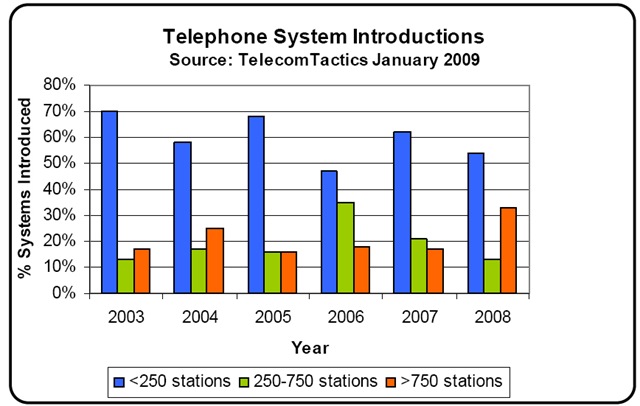
According to a study conducted by Database and analyst group, TelecomTactics, a division of T3i Group LLCThe telecom, more manufacturers are focusing on small and medium business while introducing new telephone systems. More than two-third of new telephony business introduced in 2008 were targeted at small and mid-size businesses.

Database and analyst group, TelecomTactics, a division of T3i Group LLC, findings:

2008-graph

Small and Mid-size Business (SMB):

Leading manufacturers like Aastra, AltiGen, Avaya, Cisco, Epygi, ESI, Grandstream, Mitel, NEC, Nortel, Panasonic, Toshiba and Vertical Communications have introduced nearly 20 new platforms in 2008.

Some telephone manufacturers introduced new products in their existing product families while other telephone manufacturers entered new market segment by introducing their new products.

Here are some telephone manufacturers who introduced new products in their existing product families.

  • Toshiba’s Strata CIX1200, Nortel’s Business Communications Manager 450 (BCM450) and Epygi’s QuadroM 32x introduce a higher capacity version within their respective product families, and also provide an affordable migration for the installed customer base.

Here are some telephone manufacturers who introduced new product in new market segment

  • Grandstream, which is actually a designer and manufacturer of SIP phones, IP Video phones and analog adapters and gateways since 2002, entered the VoIP system market in 2008 with its first IP PBX - the GXE502x for smaller businesses. AltiGen which is actually a business phone system provider that previously focused on SMBs and distributed businesses opened a new market with the MAX Communications Server that is a software-based VoIP phone system for larger businesses.

Top applications for SMBs in 2008 focused on business continuity with capabilities that facilitate collaboration and the ability to reach others quickly and efficiently. Manufacturers are focusing on time-saving improvements and cost savings possibilities with new unified communications software.

Larger Enterprises:

Though SMB systems dominated in 2008, larger businesses were not completely overlooked. Manufacturers introduced several new enterprise-level systems, including software-based VoIP phone systems from Aastra and AltiGen.

  • The Aastra 5000 IP telephony software, based on open standards and the Linux operating system, scales from 500 to 150,000 users (15,000 per server) and can accommodate 2,000 sites.
  • AltiGen’s MAX Communications Server (handles up to 5,000 users or 1,000 users per single server) is a software-based VoIP phone system that runs on standard Intel-based servers and integrates with Microsoft Exchange Server 2007 unified messaging and Microsoft Office Communicator

2008 Rollouts

Manufacturer Platform Maximum Stations
Small (under 100 stations)
Epygi Technologies, Ltd. Quadro6L 18
Epygi Technologies, Ltd. Quadro4Li 18
Cisco Systems, Inc. Unified Communications 500 Series (24-user) 24
Vertical Communications, Inc. SBX IP 320 32
ESI (Estech Systems, Inc.) ESI-50L Communications Server 40
Aastra Technologies Ltd. AastraLink RP (A Microsoft Response Point System) 50
Aastra Technologies Ltd. AastraLink Pro 160 50
ESI (Estech Systems, Inc.) ESI-50 Communications Server 52
Panasonic Communication Systems Network Communication Platform (KX-NCP500) 68
AltiGen Communications, Inc. MAX2000 100
Grandstream
Networks, Inc.
GXE502x 100
Small (101-250 stations)
Panasonic Communication Systems Network Communication Platform (KX-NCP1000) 108
Epygi Technologies, Ltd. QuadroM 32x 192
Medium (251-750 stations)
Nortel Business Communications Manager (BCM450) 300
NEC Unified Solutions, Inc. UX5000 Communication Server 512
NEC Unified Solutions, Inc. UNIVERGE SV8100 Communication Server 512
Large (above 750 stations)
Nortel Software Communication System (SCS500) 1,000 (targets 30-500)
Toshiba America Information Systems, Inc. Strata CIX1200 1,000
NEC Unified Solutions, Inc. UNIVERGE SV8300 Communication Server 1,152
Mitel Mitel Communications Suite 5,000 (targets 100 and up)
AltiGen Communications, Inc. MAX Communications Server 5,000 (1,000 per server)
NEC Unified Solutions, Inc. UNIVERGE SV8500 Communication Server 16,000 (4,000 per server)
Avaya Inc. S8730 Server 36,000
Aastra Technologies, Ltd. Aastra 5000 150,000 (15,000 per server)

Source : T3i Group LLC, Tarifica TelecomTactics TelecomWeb InfoTrack

In 2008, more than two-third of new telephony business introduced were targeted at small and mid-size businesses. With the current economic landscape, do you think the trend will continue in year 2009? Will manufacturers continue to focus on SMBs?

Related Posts with Thumbnails